Good question. A heads up: There is no simple answer, as is the case with many things in life. How did I know? I didn’t, for a long time…
This will be a series of posts about why and how we become pilots, the motivation, the good things and the ugly.
A bit more about “The Hungry Pilot”
I started flying at the age of 27. It was on my radar already earlier, but I never had this childhood dream to become a pilot. At the age of 24 I applied with Austrian Airlines for their sponsored ab-initio training course. The selection process consisted of 3 steps, different aptitude tests and screenings, psych evaluations and interviews. Guess what, I dropped out already in the first round.
The organization conducting the assessment gave only face-to-face feedback, which would have required another trip to Hamburg. It did not seem feasible to me at this point, because my mind was already set to “I don’t have what it takes” anyway. I continued doing other things that brought me joy and money at that time, for another 3 years.
It was between 2006 and 2008, when I spent a lot of time in the US doing private and work related things. Flying, that idea was still in my head and somehow I couldn’t get it out of there. So I decided to start my pilot training in San Diego, California, to obtain a Private Pilot License (PPL), initially without having any intentions to become a commercial pilot. I changed my mind quickly though, and after just a couple of flight hours in my book I knew: “That’s it. I want to do this for a living.” I had caught the flying-virus, and for most of us luckily there is no cure.
(To be continued…)
First, the dark side
If you have come this far, I assume you are a “wannabe”, who has already done some research and has some idea of what to expect in and from this industry. You already know that aviation is very likely the most volatile industry out there. All it takes to disrupt it completely is a crisis like Covid. Since 2000 we have seen 3 crises which had major impacts on aviation, and subsequently on the pilot training and job markets. Keep one thing in mind: The question is not if there will be another crisis. The question is when is it going to hit us? You better have a plan B when the industry is going down the drain again, and a college degree or being established already in some other profession are not bad for starters.
Aviation is a cyclic industry, it will always go up and down. Subsequently, that also applies to the pilot job market, and right now is a good time to become a pilot. In the US we see an employees market, meaning that companies are desperate to find people flying their airplanes, and therefore they have to attract pilots with outstanding terms and conditions. In the US these Ts&Cs are seriously sweet at the moment, something we can only dream of over here in Europe. Nevertheless, also here in Europe and other parts of the world your chances to land a job soon after your training are quite good these days. I will come back to this topic (Europe vs. US vs. rest of the world) in a separate post soon, so make sure you subscribe for my updates 😉
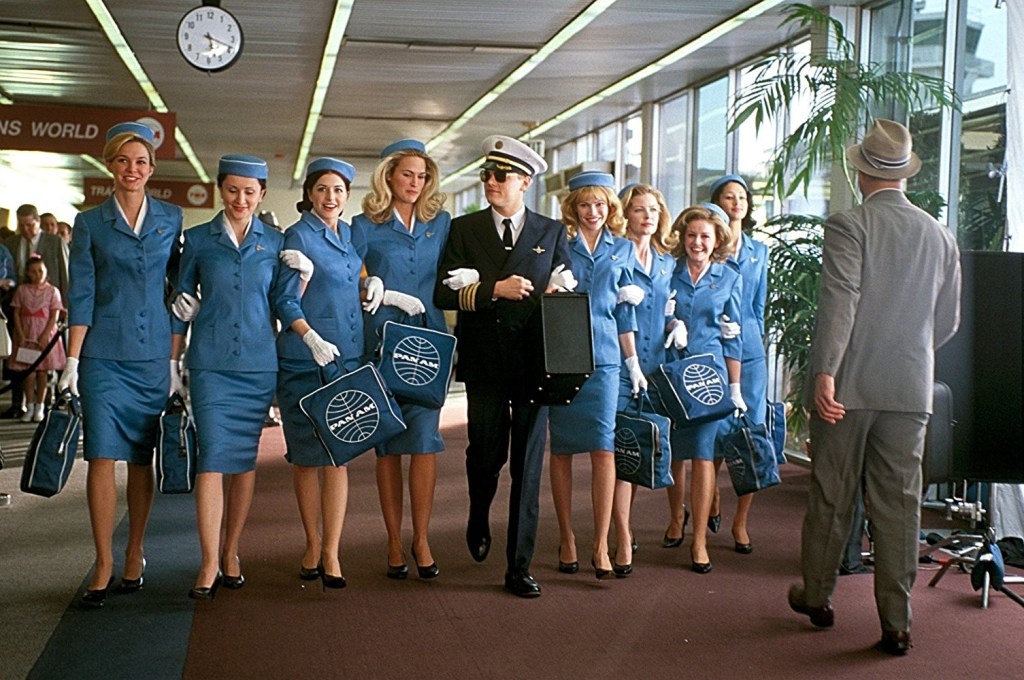
You are also aware that the golden times for pilots are long gone, despite the crazy competition for pilots we see between airlines in the US, and the general worldwide recovery and growth of aviation after Covid. The scene in the picture above from “Catch me if you can” might have some truth behind it, but only 50 or 60 years ago. As soon as the industry goes belly up again and the job market changes to an employer market, the Ts&Cs will deteriorate and in a severe crisis like Covid, a lot of us might end up unemployed (again).
The long and exhausting days flying multiple sectors, lots of nights every month spent in hotels away from family and friends, and working on weekends and holidays, all of that does not scare you off? Or being squeezed like a lemon for the very last drop and going to work fatigued, because otherwise your CEO won’t get his full bonus, but it’s all legal because he’s in bed with the aviation authority which is overseeing your company? Then the sometimes ridiculously low pay for rookies and the atypical forms of employment which are increasingly popular among European carriers and business aviation operators might do the trick. These schemes make you, the pilot, an entrepreneur with your own company, selling your piloting services to the operator. So everything’s on you: Paying your taxes and social security, typerating and maintaining your license current, uniform, etc. And the best part is, you get paid only when you actually fly. Being home sick, that’s on you. This is something which can be frequently found in Europe and less developed parts of the world.
The worst of all are the so-called “Pay to fly” or “P2F” schemes out there. These “programs” will set you back by a substantial amount of money in return for a typerating and a couple hundred of flight hours as First Officer in the cockpit of a B737 or A320, if you go fancy. You might as well find yourself in some worn out turboprop which you are going to fly in a country you probably can’t even locate on a map, sharing the airspace with bullets flying around courtesy of your local warlords. A great story about the life of a contract pilot, P2F and flying in an “austere environment” can be found here. Bottom line though is: Stay away from P2F! You only contribute to the industry-wide deterioration of Ts&Cs.
Don’t get me wrong
I’m not here to scare you off, I just want to give you a heads-up of what to expect in this industry. On the contrary, I would like to encourage you to not give up your dream and to show you that there are several different pathways into a cockpit. It took me 13 years from finishing my training to first flying a jet for money. More on that later. As much as there are terrible examples out there, there are also the good outfits, which still are a joy to work for. So in part 2, let’s have a look at what you can do to stay clear of the bad ones…
#studentpilot ATP ATPL Aviation flying learntofly pilot studentpilot travel

 The Hungry Pilot
Leave a comment