In this part of our series about what is needed to become a professional pilot we will have a look at the required skills. First a little teaser though, this is what I saw the other day arriving at my homebase:
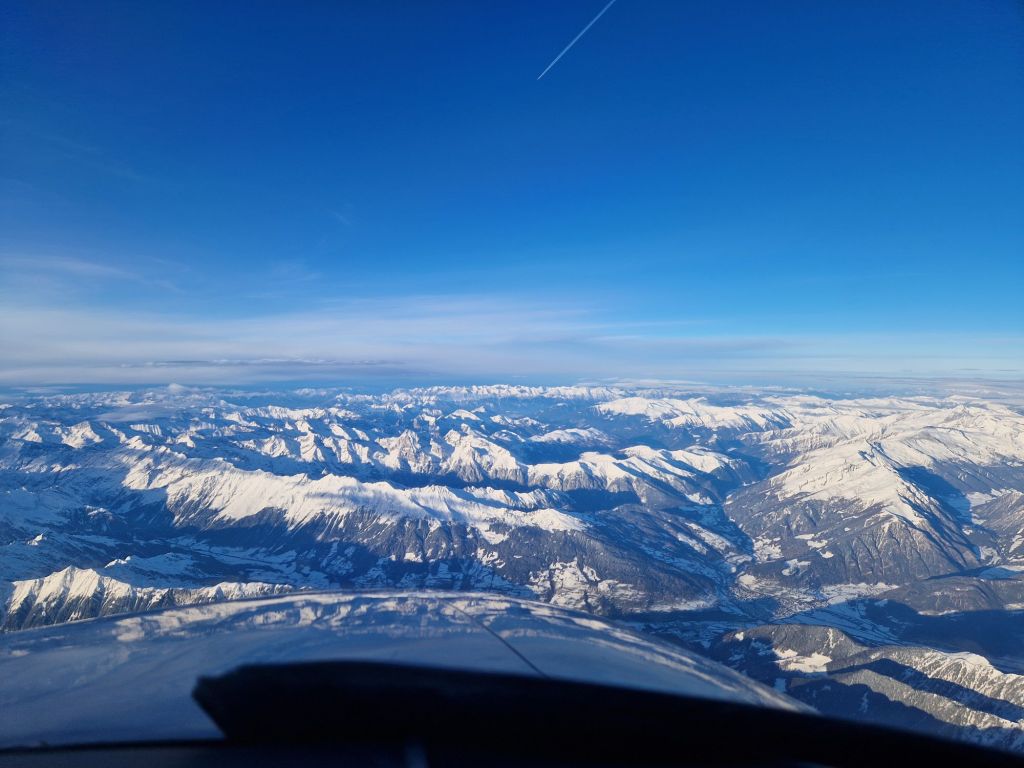
Yep, flying is awesome.
What you will find in this article:
- Hard and soft skills pilots need
Skills
There is this legendary book about flying called “Stick and rudder”. It was written by Wolfgang Langewiesche in the 1940s and every pilot should read it, ideally early during basic training. The author calls flying an art. Being a pilot, how could I disagree, but I also see it like a craft which can be learned. It does not require outstanding talent or superior sensual and multitasking skills, all while being a math and physics genius. Of course it helps if you are gifted with these, but you can still become a great pilot if at least the basics are there.
Hard skills
Knowledge, math, mental arithmetics
Becoming a pilot requires intense studies of various theory subjects, even on a PPL level. As evolution has not given us wings, only technology and machines make humans fly. Therefore, a certain amount of knowledge about how these machines work and the environment in which they are operating in is required. Math, physics, mechanics, electricity and how it works are among the most important subjects, which you usually study during school already. If it’s been a while since you studied these, you want to brush up your knowledge a bit, especially if you’re about to go to one of the airline selections. You will be tested.
Mental math is also a crucial skill, which you can luckily train for free if you want. When flying, there’s a little math problem here and there for you to solve, I dare to say during every flight. You can practice mental calculations even while driving. For example, calculate the ETA (Estimated Time of Arrival) at a certain town, based on your current speed and distance from that town. Do it over and over again and you will notice your progress. But of course, always make sure to focus on driving first. In any case, challenge yourself and don’t use a calculator for the most simple and basic calculations. It will pay off in the long run.
Multitasking
I’m putting this one under hard skills, but it might be better placed in the soft skills section here. If I’m completely off from a scientific standpoint, please feel free to tell me and I’ll be happy to correct this.
It is a widely believed legend that pilots have superior multitasking skills. And that’s what it is, a legend. Humans are just not able to perform multiple complex tasks simultaneously, at least not with a high quality performance over time. What we (pilots) might do better than others, is prioritising tasks and focusing on workload management. And that is something you can train, and in fact a good part of practical your training will include this.
Spatial orientation
One of the core skills of a pilot is to fly safely in instrument conditions. In these, your only reference to determine the attitude of your aircraft and to control its flight path are your instruments. Typically that happens inside clouds or during a pitch dark night with no lights on the ground, or without other visual cues like the horizon.
In these conditions you will need to navigate, while maintaining control of the aircraft. Navigation nowadays means that you mostly follow a magenta coloured line on your instruments and navigation displays, but you will still be required to learn how to navigate “the conventional way”. We also refer to it as “flying under raw data”, and raw data is some output on an instrument which was not processed by a computer (like an FMS or a standalone GNSS unit). So during your training, but also later mostly during job assessments, you will encounter something like this:
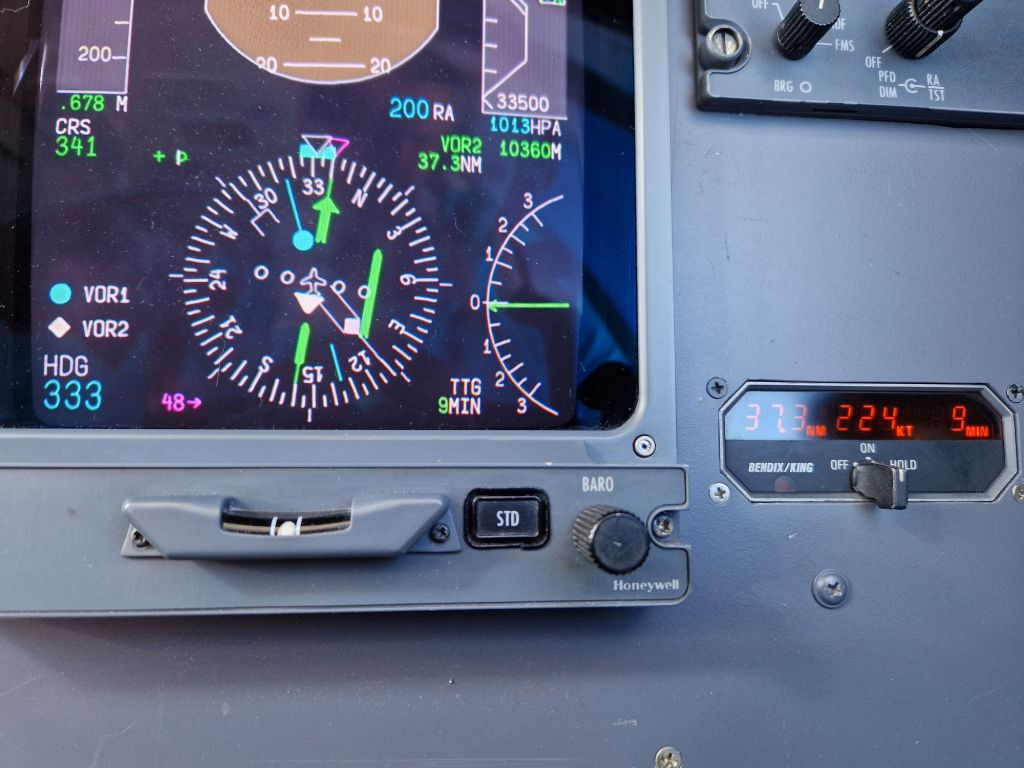
Based on what you see there you will have to figure out where you are, usually relative to a ground-based navigation aid. Since flying is expensive, in many cases you will be paid to just not wander all over the sky for fun, but you will have a task to accomplish. In other words, usually the one who pays you will tell you where to fly, and part of your job is to find that spot only with the help of these needles on the compass rose.
In the beginning there are a couple rather abstract concepts to grasp, but this is another skill which can be trained. You will get better over time, however, some people will always struggle with this more than others, and for some it is too big of an obstacle already during their training.
Soft skills
Communication & English language
There is always some kind of communication going on in a flight operation, and for the sake of safety it is absolutely essential that it is clear and efficient. This is another important part of training and often it begins already well before you hop into your training aircraft for the very first time.
If you are completely new to aviation it will be a lot to learn, especially if English is not your first language and you are going for the professional route. There’s radio phraseology including the ICAO alphabet, in English and often in your native language, and there is a good chance that you will be tested in both languages in order to ensure you are able to communicate on a minimum operational level. If there is no test or radio license to be acquired before your first solo flight like in the US, then your flight instructor will ensure your radio skills are sufficient before sending you off on your own.
If you are not sure if your English skills are good enough, ask yourself if you are able to have a fluent conversation. This will be a good starting point and if the answers to this question is no, start working on your skills immediately. You can find the different proficiency levels defined by ICAO here, and level 4 is the minimum you need to do radio communication in English.
Aviation is also the industry which is most likely using the most acronyms and abbreviations, again you will have to learn a whole lot of them.
Besides learning this technical language we are using to facilitate worldwide operations in aviation, there are also some character traits related with communication which are beneficial to pilots. You should speak up if there is something wrong which the other pilot might have missed, even if you are the copilot and if there is an authority gap in your cockpit. Ask for confirmation if there is anything you believe you have not understood. You should also point out your own mistakes rather than covering them. It is okay to make mistakes, as long as you try to learn from them.
Leadership & teamwork
Air operators always try to hire future captains. It means that they are looking for certain types of people when hiring copilots, those who have the potential to become a captain further down the road. As a captain you will be a leader of crews (or teams) of various sizes, from 2 to 20+ teammates. You will be in charge of everything and part of your job is to create a professional atmosphere, and to maintain it also during critical periods.
Most of these skills can be acquired also, nobody is born as a natural leader. As mentioned, there are certain characteristics that companies are looking for when they hire pilots, and often you will be tested for them in the form of interviews, group and role play exercises and by using psychological questionnaires. They observe how you behave in these exercises, how you treat others and if you might show any character traits that are not desirable. Keep in mind that different companies have different requirements and that you might fail an assessment, but you pass the next one for a different company. That is why it is so difficult to determine whether you are going to be a good pilot in the future or not.
Skills, skills, skills! But what is the takeaway?
There are more of those skills I haven’t even mentioned yet, like maintaining situational awareness, decision making and stress management. Before starting your flying career you might already have some of the described skills and qualities, depending on your background and experience. If you believe that you do not have certain abilities, or if you think they are not developed enough – fear not! They come with training and experience, like the actual flying skills. There are many things you can do to improve, depending on which areas you need to improve. Talk to your instructors, your captains and superiors and actively ask for feedback and tips on what to do better. Be open for that feedback and criticism, and you will get better. Your superiors will also give you feedback you have not asked for, some of it will include some inconvenient truths and things you probably don’t want to hear. Again, it is up to you what you do with it. I suggest to avoid bringing anything on a personal level, leave out the emotions as much as possible and embrace criticism as an opportunity to grow.
If you are not sure if you have the right set of skills to become a pilot, you might want to try this approach:
- Go and get tested by an airline or air force first. They usually do these selections for free and if you pass you might already have won your entry ticket to the industry. Try to assess yourself beforehand using the points from this article. Make sure you go to these selections well prepared, knowing about your strengths and weaknesses. You can usually find plenty of information on the web about the specific selection a company conducts
- If you fail, try a different company if you have the possibility. That will also depend on where you live and which languages you speak
- You can also take the self-sponsored route if the other options don’t work out. There will be lower obstacles initially in terms of aptitude tests, as long as you can come up with enough money. However, later on you will again be tested whenever you apply for your first cockpit position, even though the requirements might be different, and often less strict
Lastly, another teaser. Europe’s highest mountain seen from the office during a climb out from Sion:

 The Hungry Pilot
Leave a comment